'Dryden' Apple-1 computer
The Dryden Apple-1 is listed in the Apple-1 Registry as #14.
History of the Dryden Apple-1
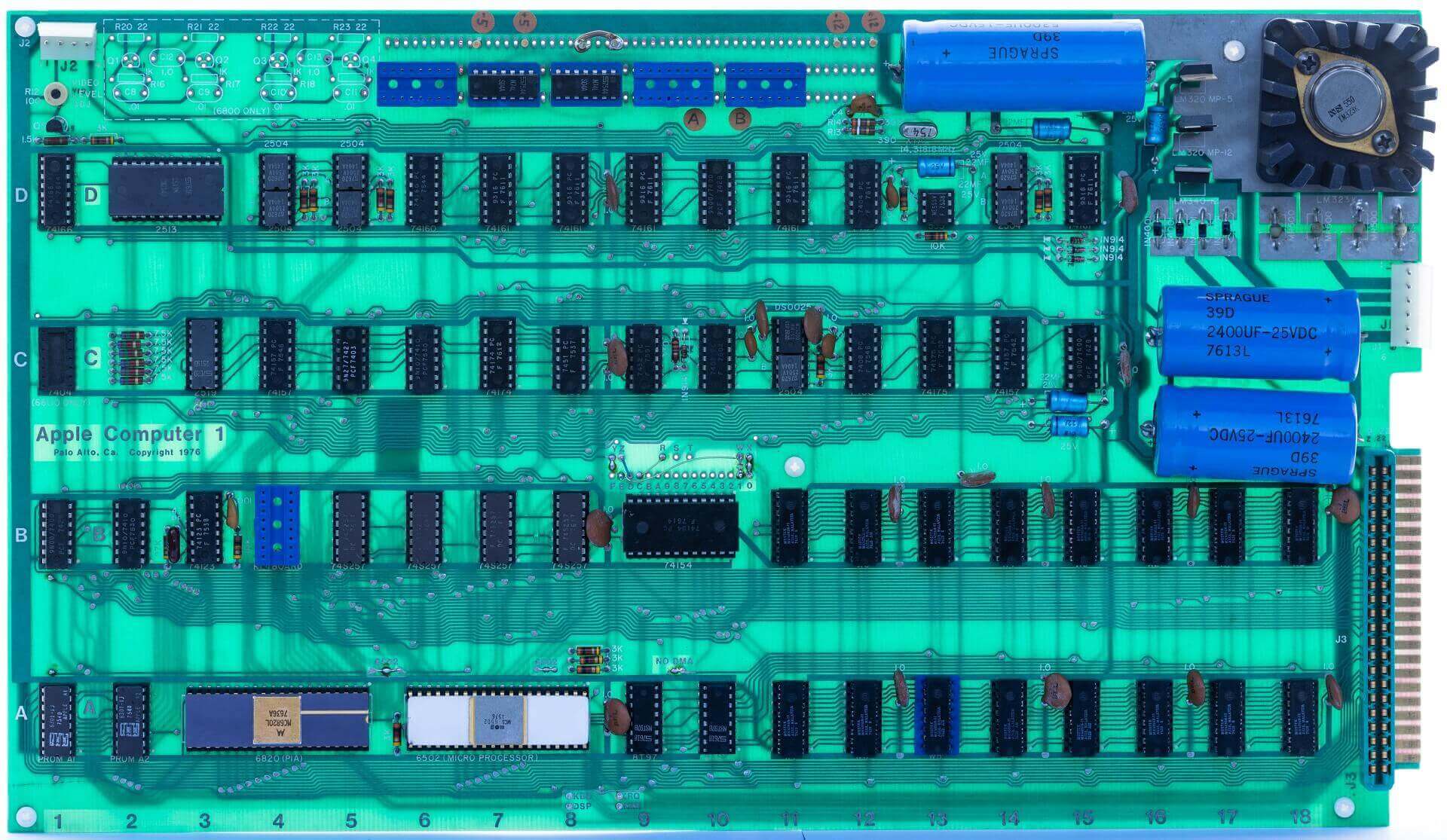
It is an original and working Apple-1 computer from the 1st batch.
In 2017, this Apple-1 was offered at auction by its first owner, after 41 years in his possession.
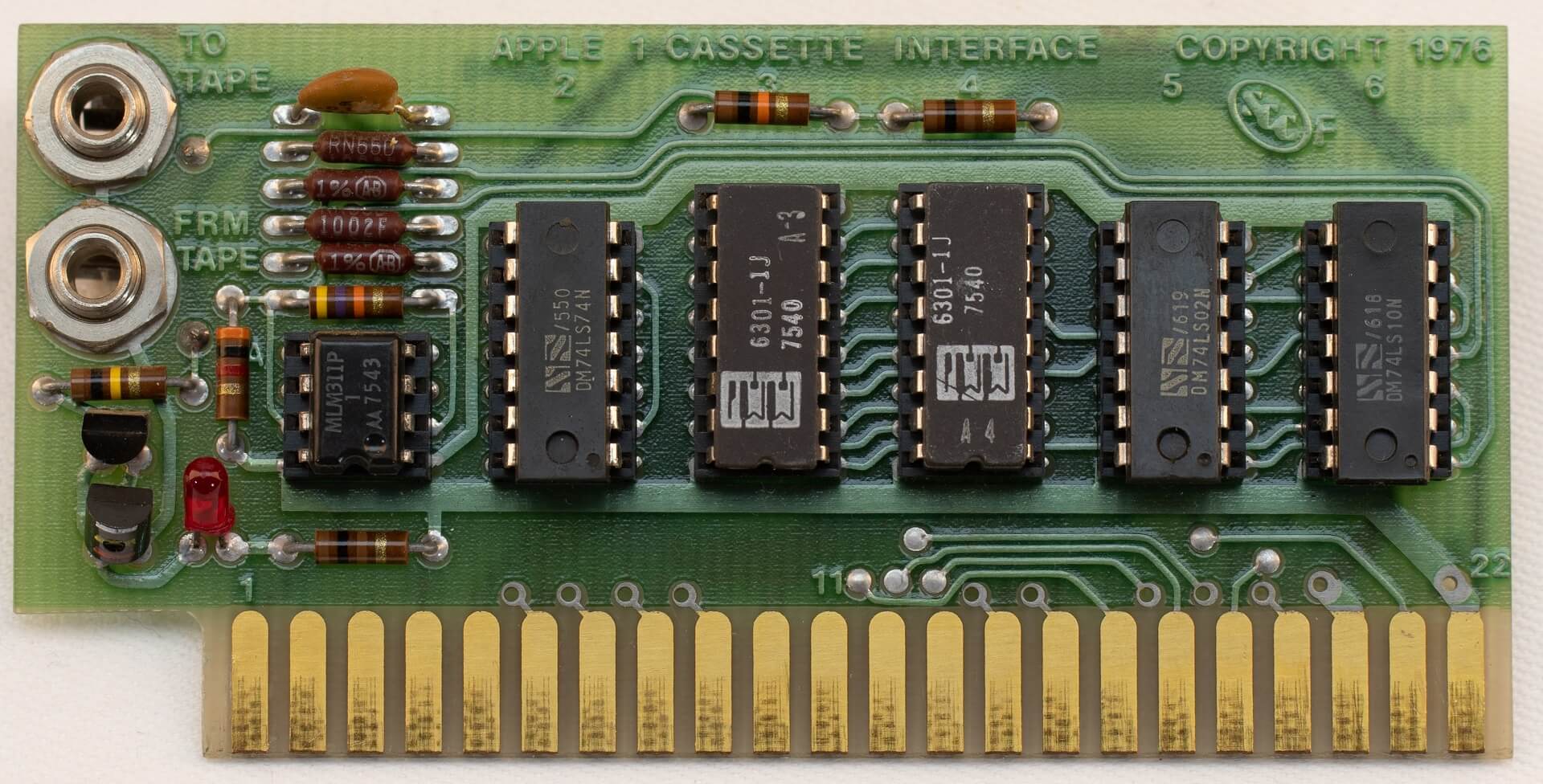
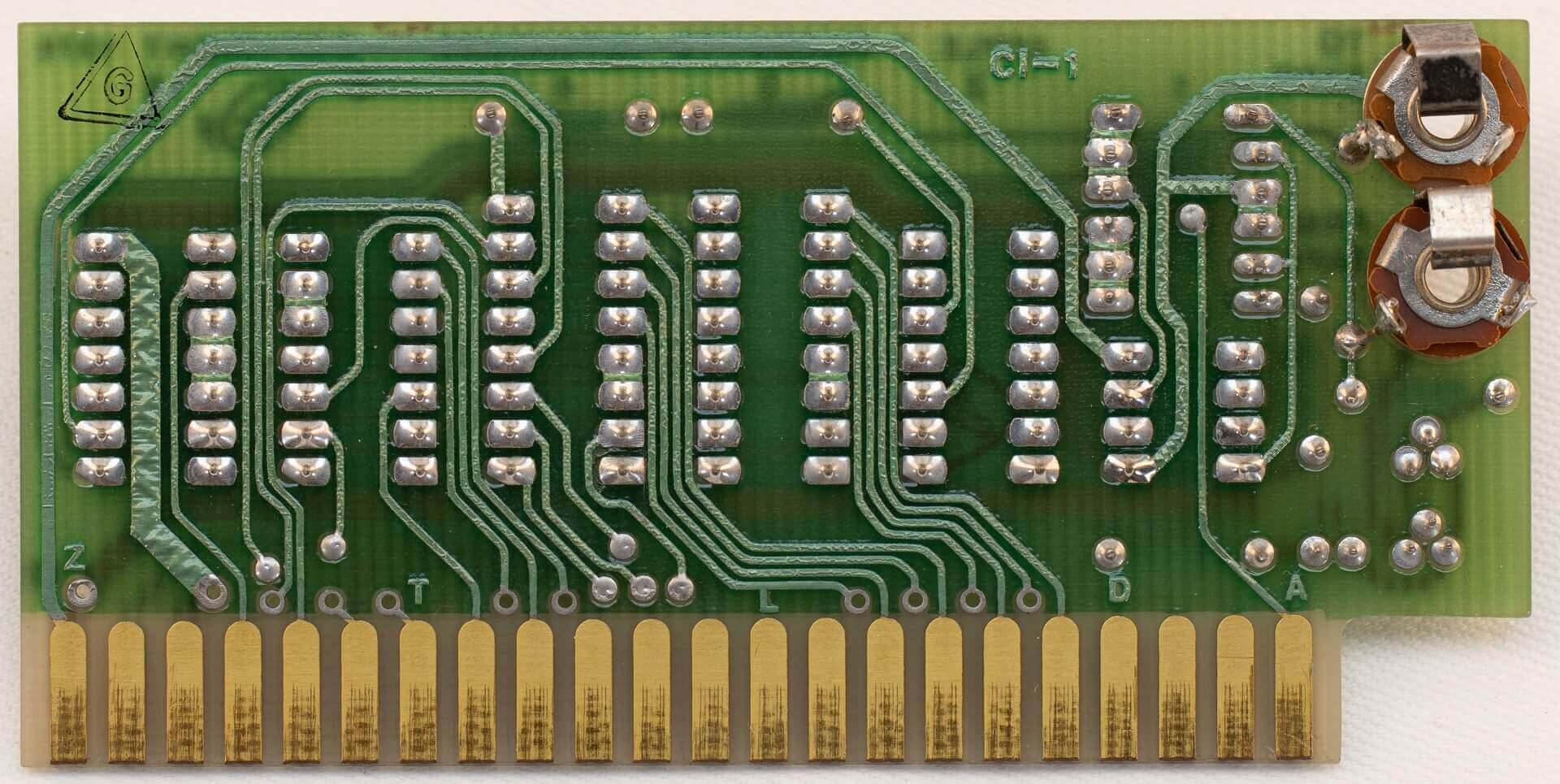
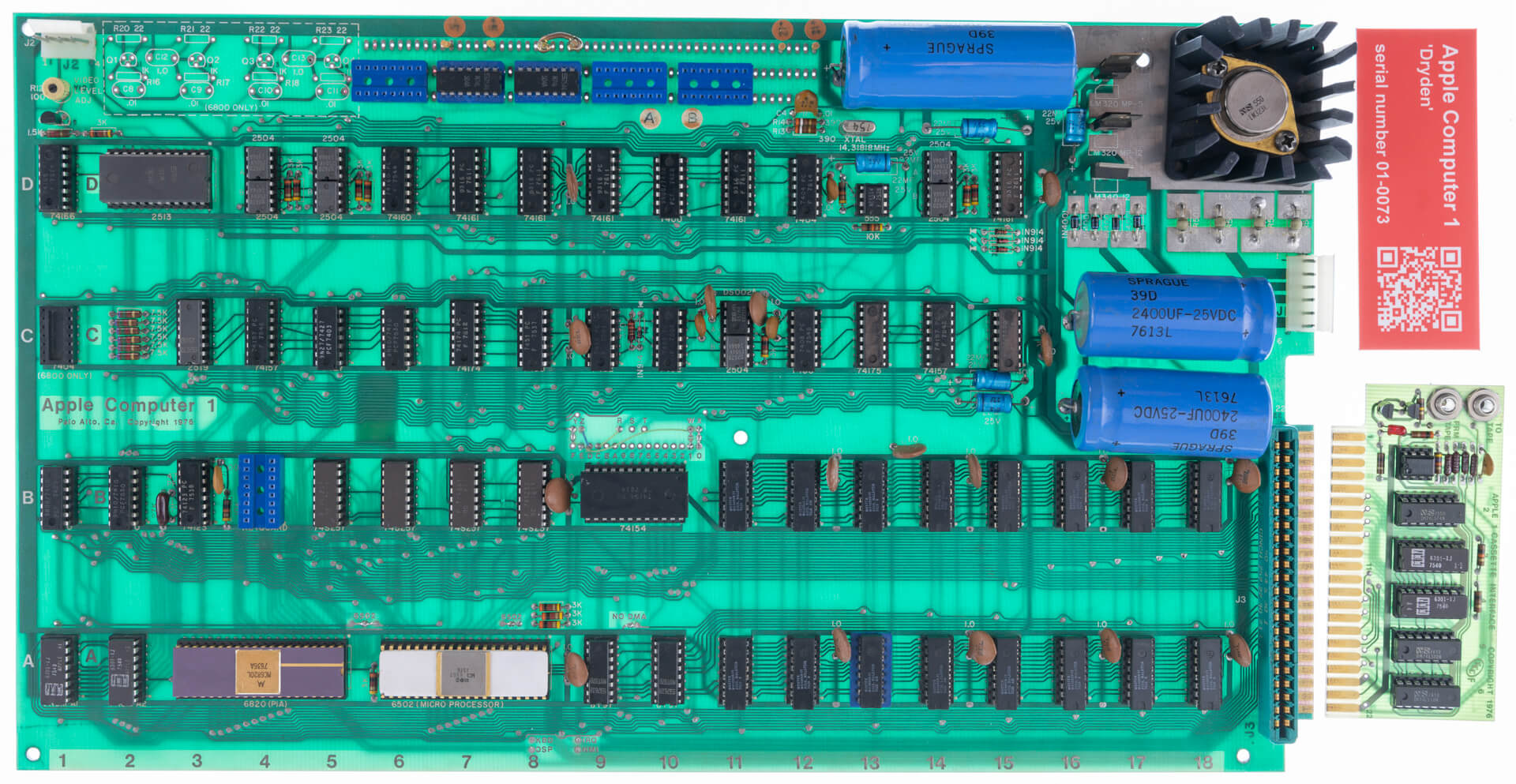
The computer came with a keyboard in a beautiful wooden case from 1976, various cassettes from 1976, original manuals and a 19-inch case in which the owner had installed the Apple-1.
As is often the case, a one-of-a-kind Apple-1 immediately stands out from the crowd when it comes with its own wooden case and keyboard.
There is also correspondence with Apple, which is unique. In 1977, the company offered all owners of an Apple-1 the opportunity to trade in their computer for an Apple II for an additional fee.
The first owner wanted to take advantage of this offer in 1979, but no one at Apple remembered it, which is why this beautiful Apple-1 has been preserved.
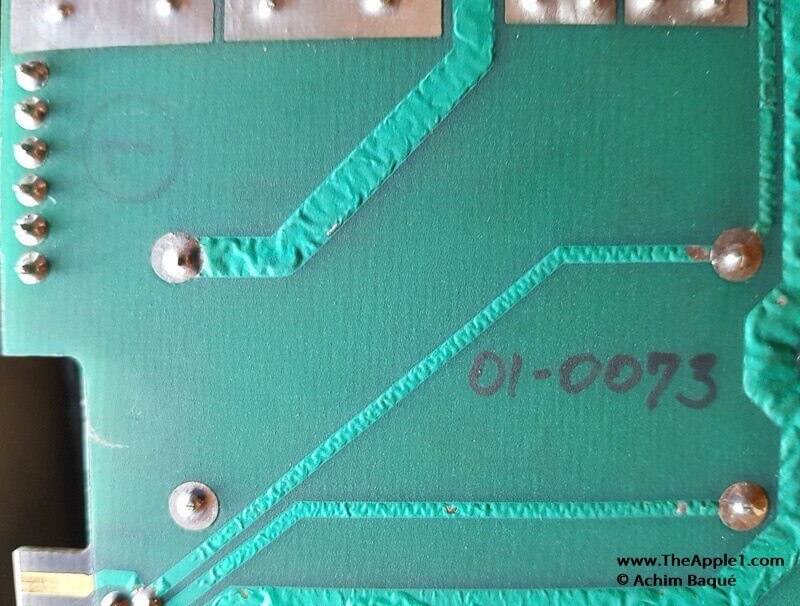
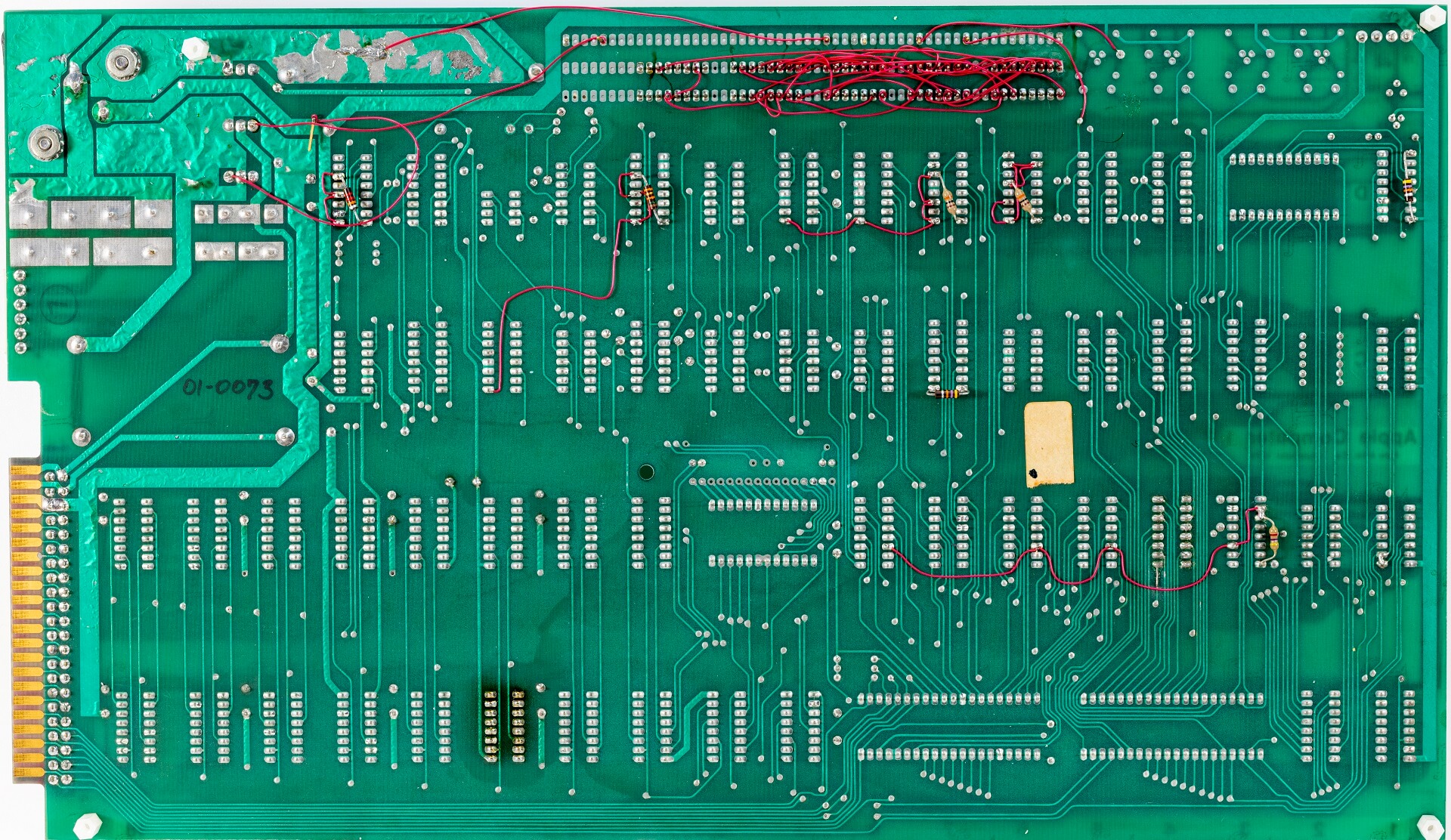
On the back, there is a round stamp with the number 7, and 01-0073 is handwritten on the back. For more information on the theories surrounding these numbers, see the Copson Apple-1.
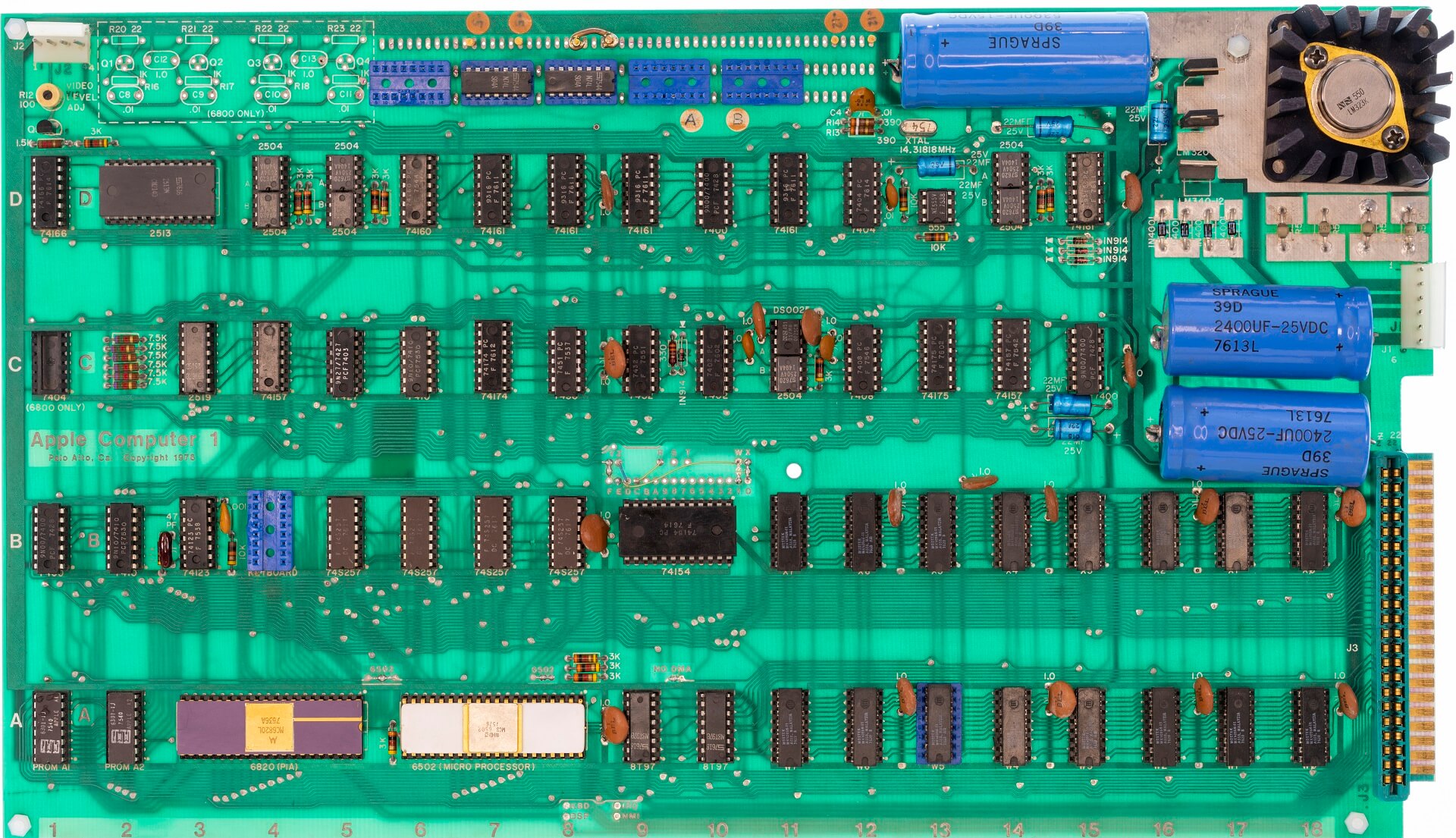
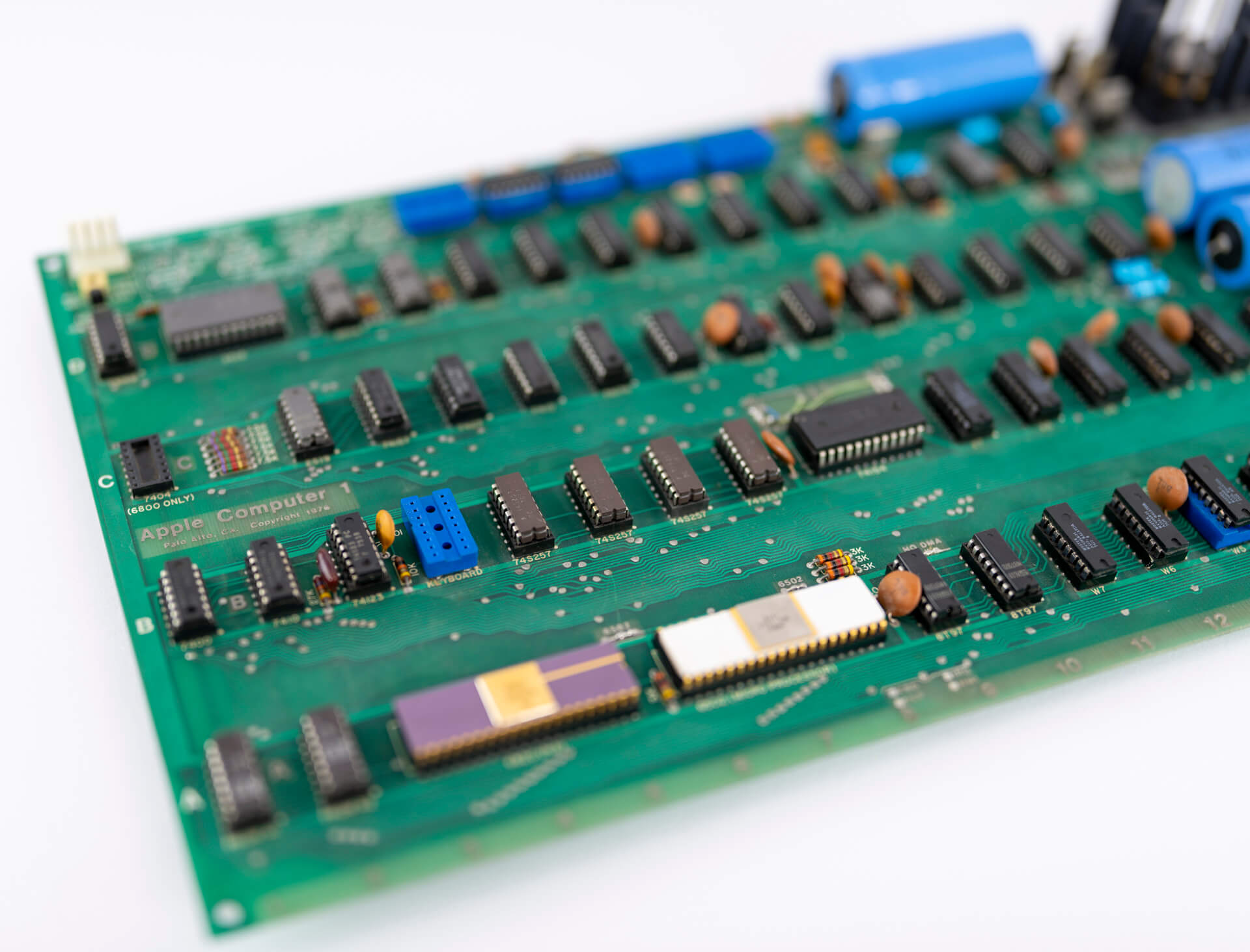
All components are as originally delivered in 1976, which is rarely the case. Components often had to be replaced, and some motherboards were even assembled decades later. In this case, only two IC sockets were replaced by the first owner.
Originals from 1976 are available as replacements. For me, this Apple-1 remains in its original state, including these modifications. After all, the Apple-1 was a home computer that appealed primarily to hobbyists.
Every Apple-1 has a prototype area in which components could be soldered, and many owners made use of it. The components added to the Dryden Apple-1 and the additional wiring show the owner’s deep understanding of this computer.
Many current Apple-1 owners have reversed changes and additions made by first owners in order to make the computer look more "original". Many collectors, experts and museums see this differently, since these changes are part of the history of the device and contribute to its authenticity. If I ever pass this Apple-1 on, it will be up to the new owner to decide.
After 30 minutes of work, the Apple-1 could look as if it had just been taken out of the box. In my opinion, however, these additional components are a historical part of the object and contribute to its authenticity and uniqueness.
On some pictures, an additional electrolytic capacitor can be seen mounted piggyback on an original electrolytic capacitor. Those are old pictures. The first owner removed this additional component, which does not affect the functionality.
The condition of this Apple-1 is very good. Some people commented on this Apple-1 without ever having inspected it in person. If these additions were removed, this Apple-1 would probably appear to some people as an outstanding example. Museums and many collectors, however, regard such interventions as controversial.
Everything is in very good condition, and the computer is still working. The Apple-1 was tested by Mr. Rudolf Brandstötter in the run-up to the auction. Alongside Corey Cohen, Mr. Brandstötter, who has auctioned two Apple-1 computers, is one of the experts who have already handled several examples of this computer. It was turned on and tested for the auction.
In November 2017, further successful tests with this Apple-1 took place.
On the back is the serial number 01-0073 handwritten by Steve Jobs.
The acquisition
The auction was unusual in every respect, and the price, compared with other Apple-1 computers, was incredibly low. The auction took place near me, and I was actually there only to buy a beautiful rocket engine as an object for my office. The expected purchase price of the Dryden Apple-1 was very high. I had inspected the Apple-1 personally at the auction house and very much liked what I had seen. The auction began, and the first bid came immediately. Then nothing happened for a long time, and the auction faltered in an unusual way. When the auctioneer called "going once, going twice, going twice," my bidding card was raised almost reflexively. Photographers appeared immediately. Again, an unusually long time passed. In the meantime, a maximum bid was being considered. Incredibly, there was no further bidding.
After the auction, I was contacted by two interested parties who, for various reasons, had not bid during the auction, but later called and offered enormous sums of money. Many owners sell their Apple-1 after a short time and regard the historically valuable device as a financial asset. For now, however, I would like to keep my Apple-1.
Soon there were prophecies of doom and hasty statements, made without knowing the reasons for the low result. Some claimed that all high prices had only been due to hype surrounding Steve Jobs, and that this hype was now over.
The opposite happened.
In the same year, 2017, several Apple-1 computers were auctioned for three to four times the price. In addition, some were offered on the private market, and nothing could be done for less than US$350,000.
Soon after the auction, the first offer arrived in what had by then become the usual price range. But as mentioned before, I am happy to own this computer and do not want to turn it into gold. My first Apple-1 had already been loaned to the Deutsches Museum Munich.
More and more Apple-1 computers are going to museums. In addition, there are collectors who will probably never give up their Apple-1 during their lifetime. In a few years, the market may dry out.
Acquiring an Apple-1 will become more difficult and more expensive over time. There will always be exceptions, and sometimes also luck for the buyer.
For the time being, this Apple-1 is stored in a bank safe. The Dryden Apple-1 should either go to its own museum or to a travelling exhibition.
Exhibition at ZKM Karlsruhe, Germany
From July 14, 2018 until February 10, 2019, the Dryden Apple-1 was on display at ZKM, Center for Art and Media, Lorenzstraße 19, 76135 Karlsruhe. ZKM Website (German only, please use an online translator).
The exhibition was called „Kunst in Bewegung. 100 Meisterwerke mit und durch Medien.“ (Art in motion. 100 masterpieces with and through media).
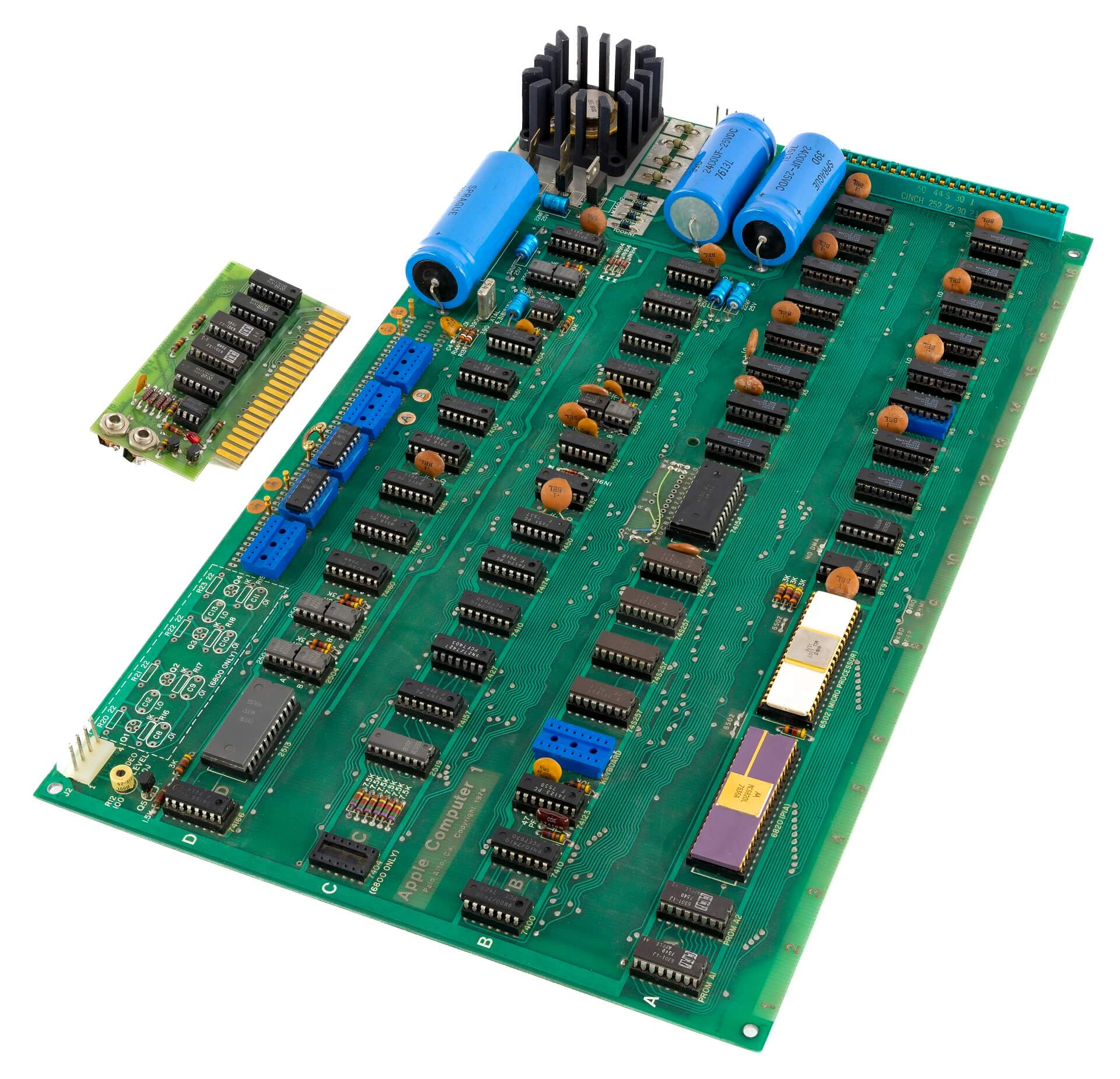
A custom box was built to protect the mainboard, cassette interface and keyboard. It was transported to Karlsruhe by a specialist carrier in June 2018.
The Apple-1 remains in the condition in which its first owner used it in 1976. The first owner added some parts and replaced a socket. In my view, after more than 40 years, this is part of its history and belongs to the board. This condition is preserved. No cleaning has been done. That is the approach many museums prefer. Restoration would only be done if the artifact were endangered or badly damaged. But this Apple-1 is in working condition, and all parts are original. Nothing has been changed, and no components have been added or replaced later, except for the keyboard socket and the parts added by the first owner in the 1970s.
The electronics added in 1976 are inverters used for the keyboard. The keyboard is homemade, as were all keyboards used for an Apple-1 in the 1970s. Apple did not offer a keyboard.
The added components, the inverter ICs, were necessary to use some keyboards in 1976. Many Apple-1 computers have been modified for auctions in the past. Such added parts were removed and a 1977 or even later Apple II keyboard was attached. The Dryden Apple-1 is still in its 1976 state, including the keyboard. Not everyone agrees that it is worth destroying the board’s history by removing 1976 parts merely to make the mainboard look “clean” and attach a later keyboard.
Pictures
 +
Dryden Apple-1
+
Dryden Apple-1
 +
Dryden Apple-1
+
Dryden Apple-1
 +
Dryden Apple-1 back side
+
Dryden Apple-1 back side
 +
ACI front
+
ACI front
 +
ACI back
+
ACI back
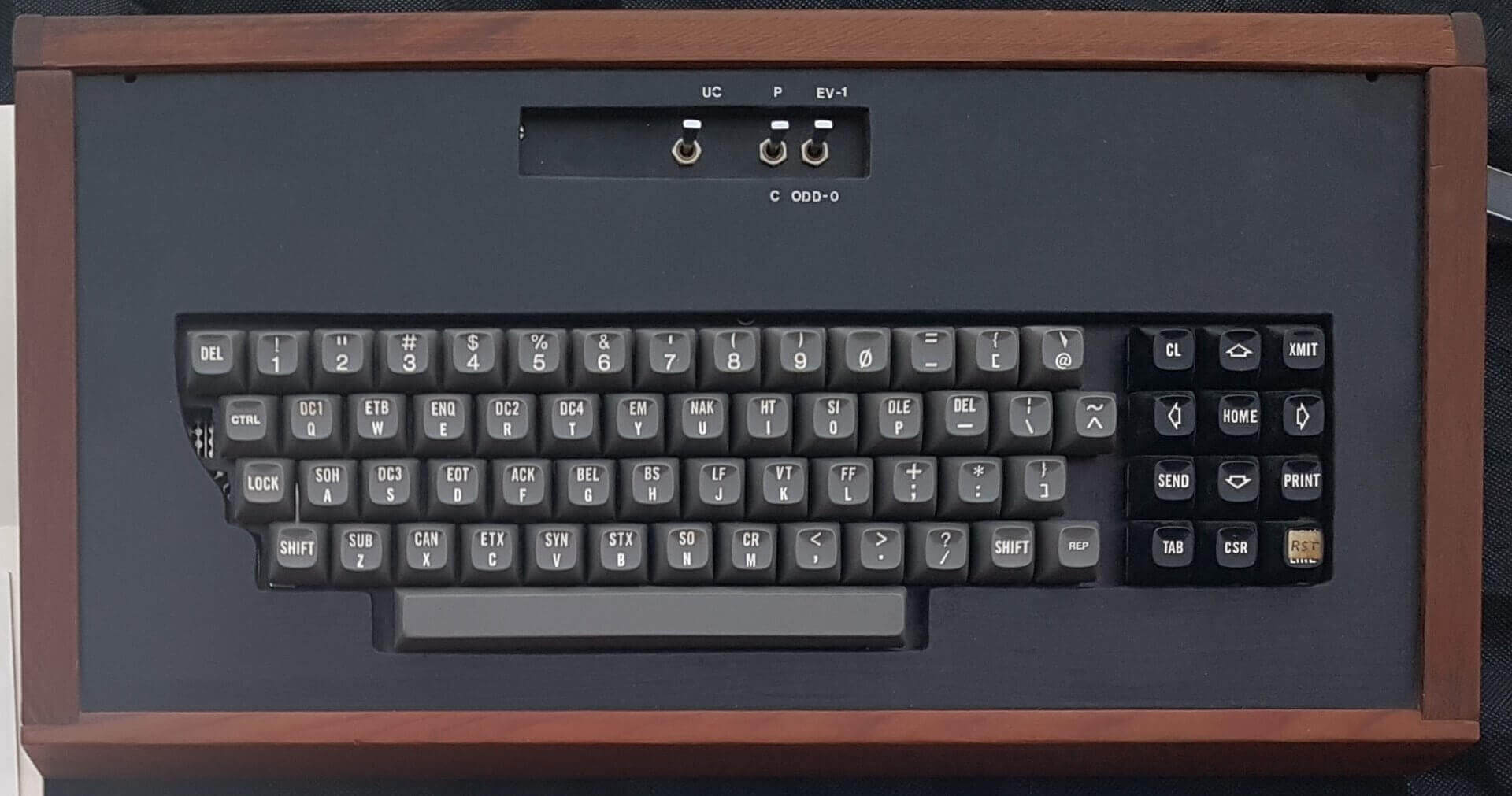 +
Keyboard
+
Keyboard
 +
19" rack
+
19" rack
 +
Number on the back
+
Number on the back
 +
Working Apple-1
+
Working Apple-1
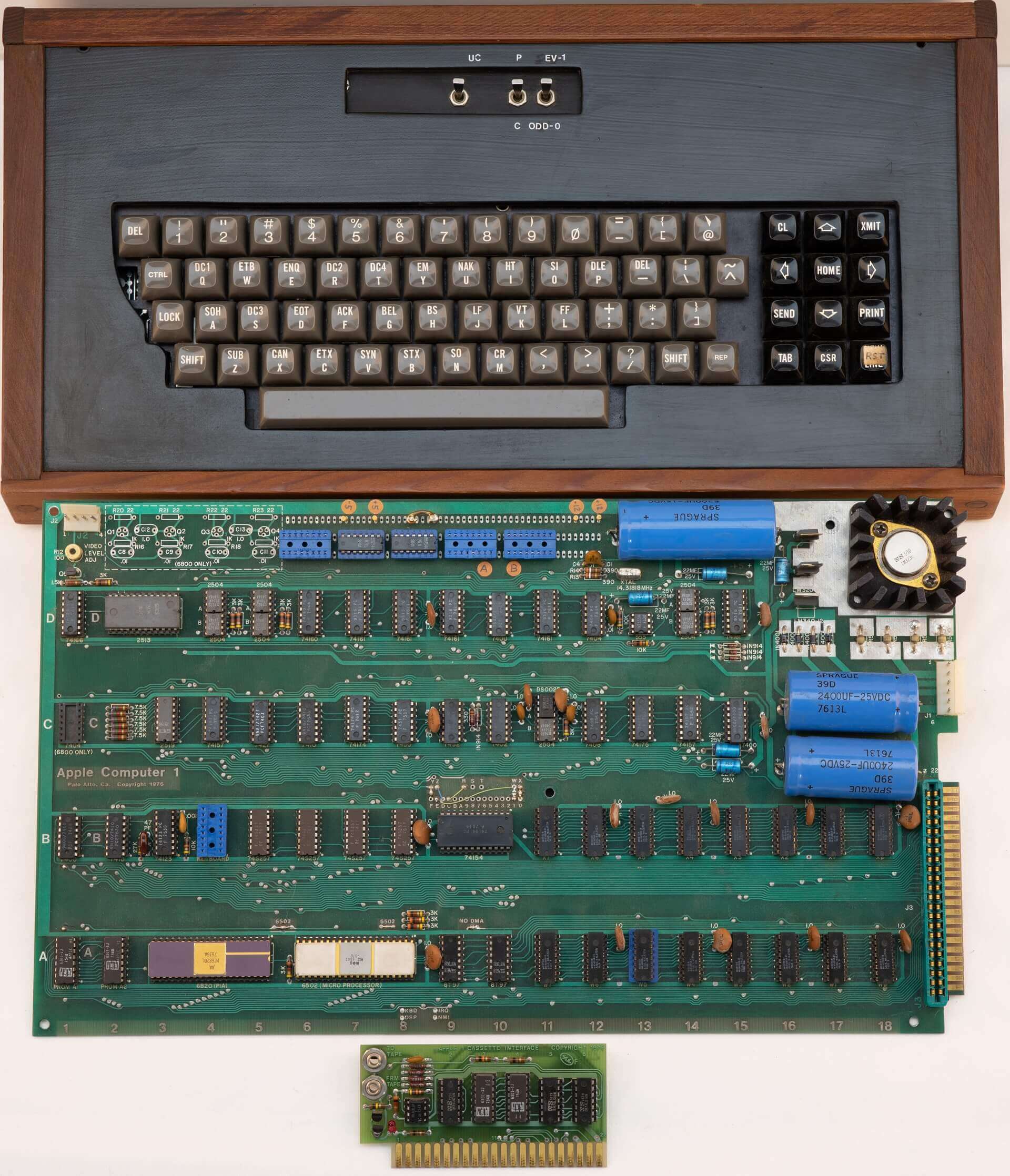 +
Keyboard, mainboard and ACI
+
Keyboard, mainboard and ACI
 +
Keyboard
+
Keyboard
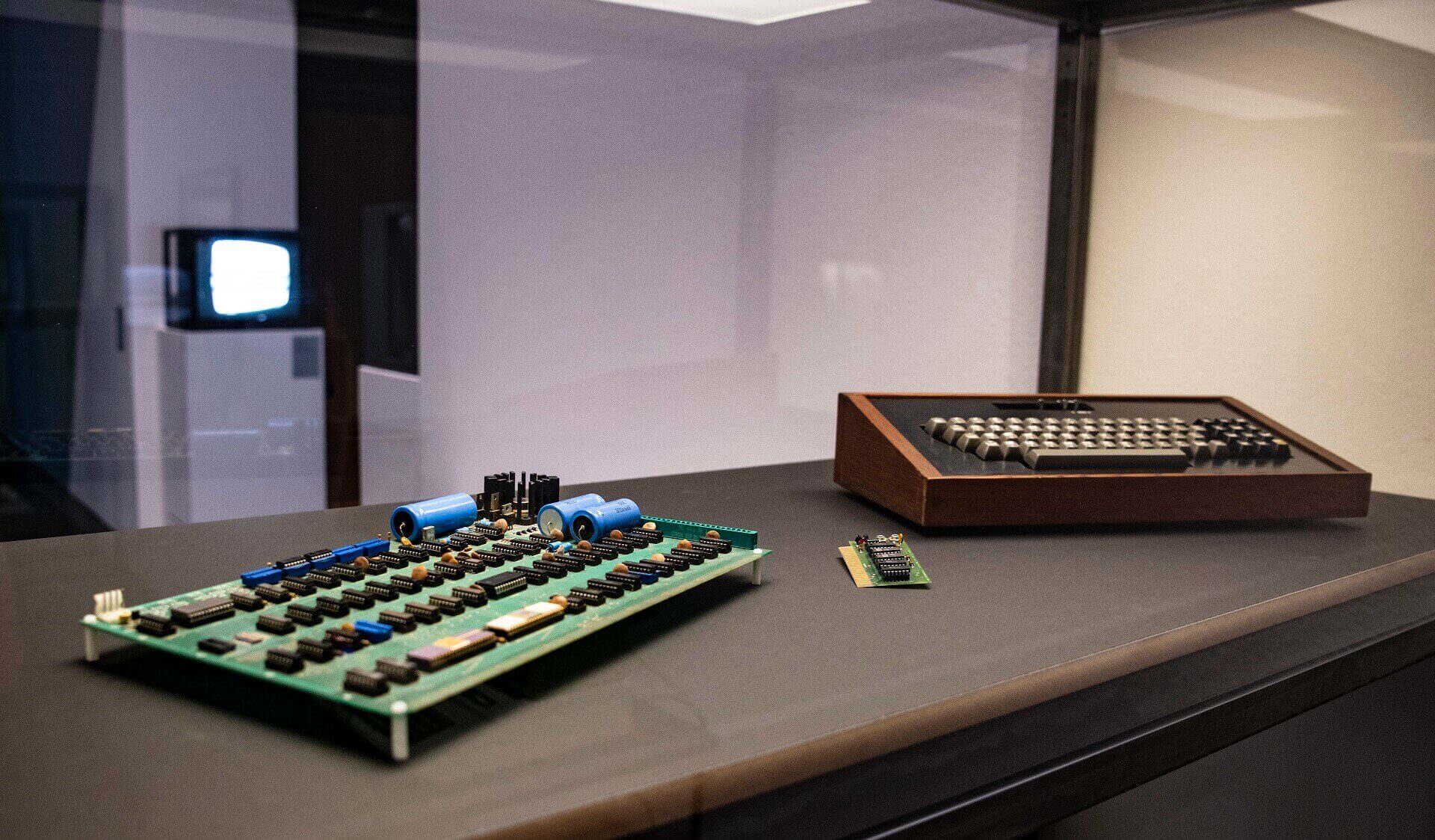 +
At exhibition in Karlsruhe/Germany
+
At exhibition in Karlsruhe/Germany
 +
At exhibition in Karlsruhe/Germany
+
At exhibition in Karlsruhe/Germany
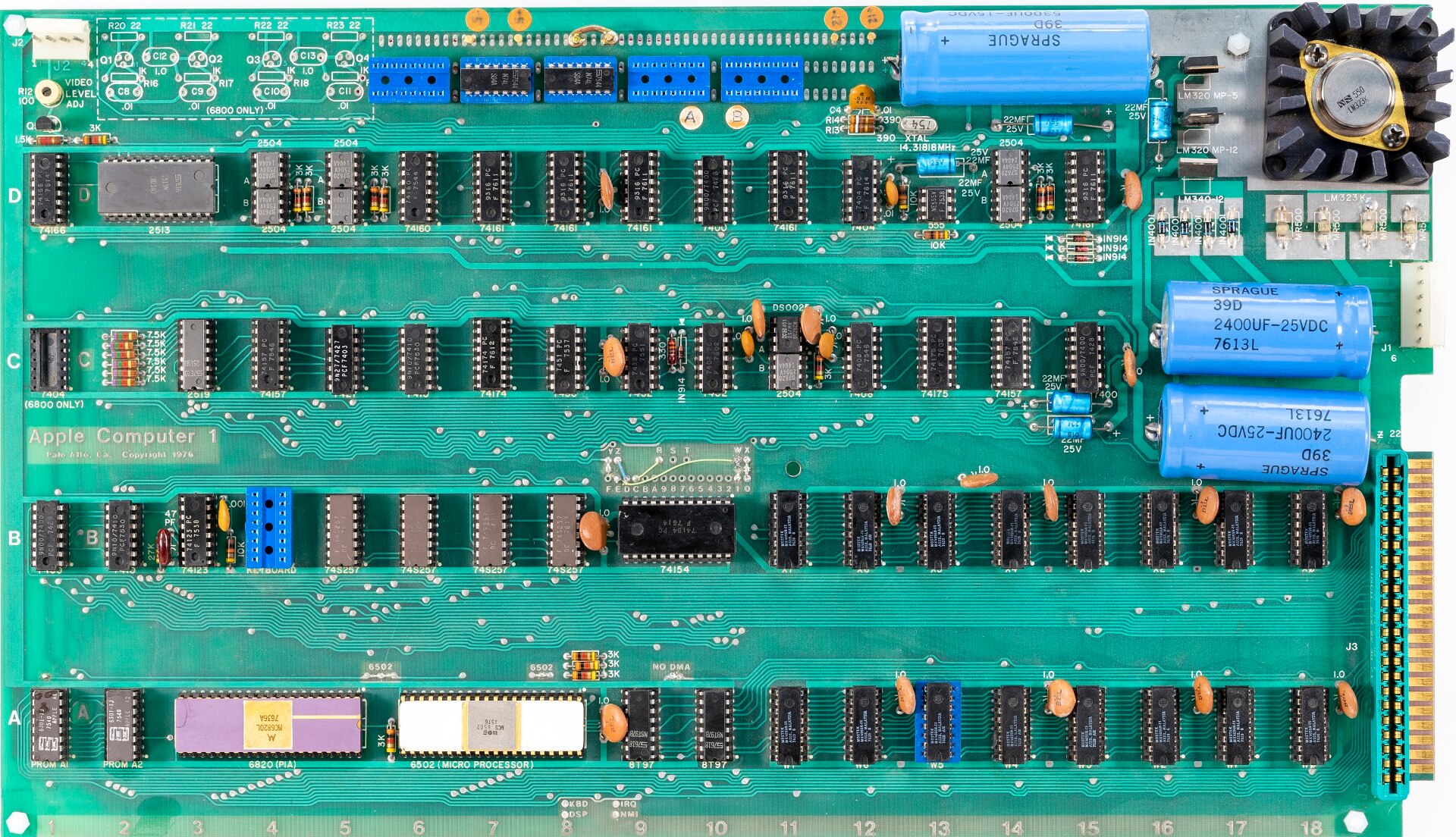 +
Dryden Apple-1
+
Dryden Apple-1
 +
Dryden Apple-1
+
Dryden Apple-1
 +
Dryden Apple-1
+
Dryden Apple-1
 +
Dryden Apple-1
+
Dryden Apple-1
 +
Dryden Apple-1
+
Dryden Apple-1
 +
Dryden Apple-1
+
Dryden Apple-1
 +
Dryden Apple-1
+
Dryden Apple-1
Apple-1 collection
My private collection currently includes these original Apple-1 computers:
'#1 Copson Apple‑1',
'#2 Dryden Apple‑1',
'#4 Heathcott / Lee Apple‑1',
'#5 Reinemer Apple‑1',
'#7 Burr Apple‑1',
'#8 Scardino Apple‑1',
and many other vintage computers. Including the very first prototype of the Kenbak-1 computer. Please contact me, if you have computers made before 1984 to offer.
These original Apple-1 computers were once part of my private collection and are listed here for historical completeness: '#9 Dreike Apple‑1', #10 Computer Closet Apple-1.